
When Therapy Becomes Content: What Happens to Therapy?
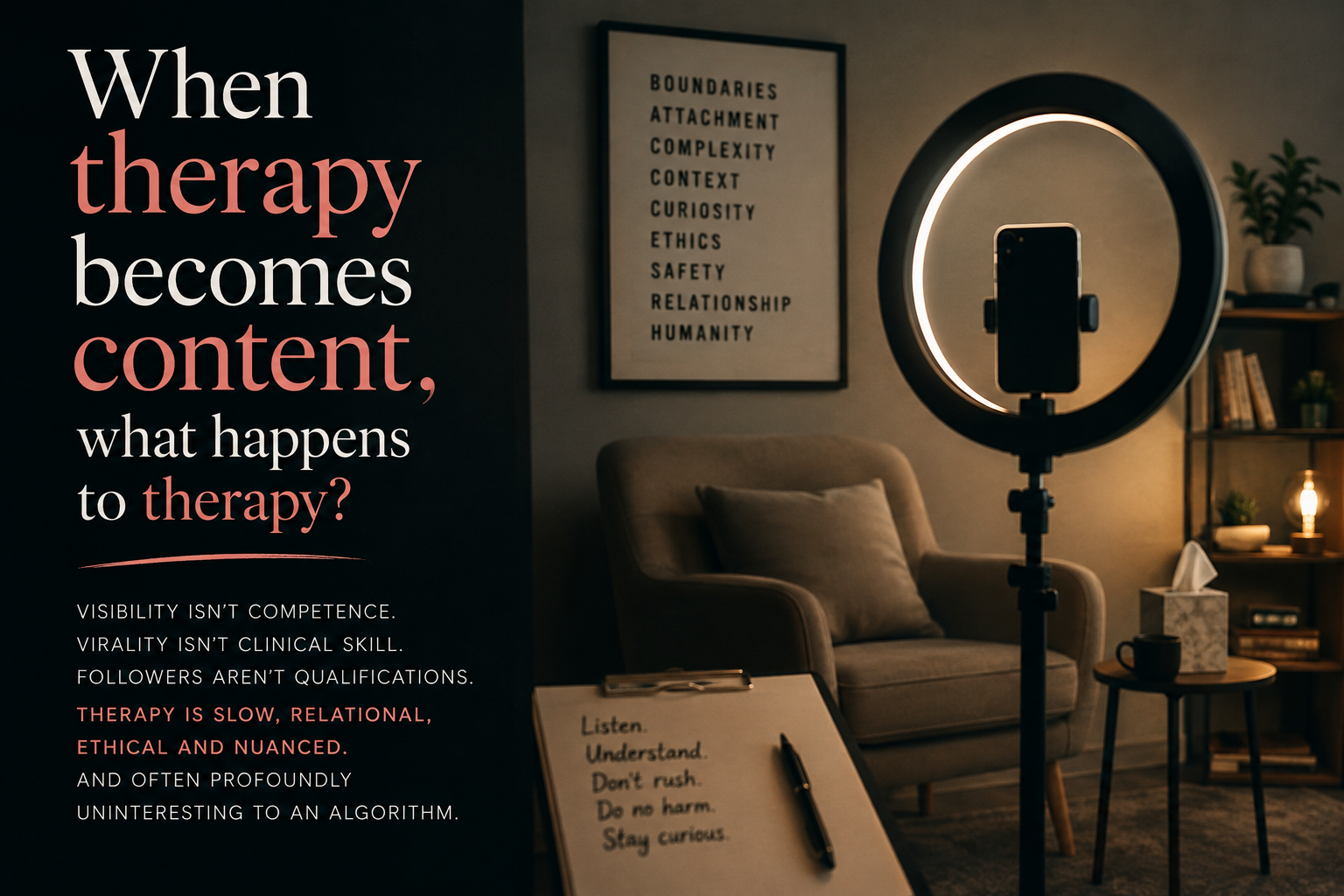
Yesterday, in a moment of genuine irritation, I asked:
“Is all it takes to become a couples therapist these days a ring light, an Instagram account and some sensationalised sexual content?”
It was a flippant question.
But the concern underneath it isn't.
I've been thinking for some time about what social media is doing to therapy — and increasingly, I'm uncomfortable with the erosion of the distinction between therapy and therapeutic-looking content.
Let me be clear: therapists don't own conversations about sex, relationships, intimacy or emotional wellbeing.
There are excellent educators, coaches and content creators doing valuable work in these spaces. And therapists need to market themselves too. I certainly do. Therapy practices are businesses.
My concern is what happens when those categories become so blurred that the public can no longer reasonably tell the difference.
Knowing about relationships doesn't make someone a couples therapist.
Being sexually confident doesn't make someone a psychosexual therapist.
Having experienced relationship difficulties doesn't qualify someone to treat them.
And having 100,000 people listen to your advice doesn't make that advice clinically sound.
Therapy is not a subject matter. It is a professional process.
And that distinction matters.
The algorithm rewards certainty. Therapy requires curiosity.
Behind what appears to be a straightforward intimacy or relationship problem can sit trauma, coercion, sexual pain, attachment injury, shame, cultural or religious conflict, medication, illness, neurodivergence, betrayal — or a relationship that isn't actually safe enough for the intervention being enthusiastically prescribed online.
Which is why good therapeutic work requires us to be able to say:
I don't know yet.
We assess. We formulate. We remain curious. We tolerate ambiguity. We consider ethics, safeguarding, boundaries and power. We use supervision. And sometimes we recognise that what someone needs sits outside our competence.
None of this makes particularly sensational content.
“Three signs your partner is a narcissist” will probably perform better than:
“There are several possible explanations for this behaviour and we'd need more context before drawing conclusions.”
But the second is much closer to responsible therapeutic thinking.
Social media rewards confidence, certainty and simple explanations.
Therapy often asks us to do the opposite.
To wonder.
To question.
To resist reaching a conclusion too quickly.
The algorithm rewards certainty. Therapy requires curiosity.
And that's quite a collision.
When visibility starts looking like expertise
Social media has also created new markers of authority.
Followers. Views. Shares. Viral videos. Podcast appearances.
None of these are inherently problematic. They may tell us somebody is an excellent communicator.
But they tell us very little about clinical competence.
Someone can be brilliant at Instagram and mediocre at therapy. Someone can also be an exceptional therapist and absolutely terrible at Instagram.
Yet online, the first can appear considerably more authoritative.
And when therapeutic language is everywhere - attachment, trauma, narcissism, boundaries, triggers, red flags - almost anybody can begin to sound therapeutic.
Sounding therapeutic and practising therapy are not the same thing.
That's important when people are deciding who to trust with some of the most vulnerable parts of their lives.
Therapists aren't innocent either
It would be very easy to make this entirely about unqualified people online.
But therapists are participating in the same attention economy.
We're encouraged to build personal brands. Find stronger hooks. Post consistently. Be provocative. Turn complex clinical ideas into easily digestible content.
And, again, I do some of this myself.
The uncomfortable question is what happens when the algorithm begins shaping not just how we communicate therapeutic ideas, but which ideas we choose to communicate.
The stronger claim performs better than the nuanced one.
The definitive statement performs better than uncertainty.
“Your partner does this because…” is more compelling than, “There could be several things happening here.”
And somewhere in that process, I think we have to ask ourselves:
At what point does making therapy marketable begin to change what we're presenting as therapy?
Are we teaching people to expect therapy to behave like the internet?
This may be the part that concerns me most.
Perhaps therapeutic content isn't only changing what people think expertise looks like. Perhaps it's changing what they expect when they enter therapy.
Tell me what's wrong with my partner.
Tell me my attachment style.
Tell me whether my relationship is toxic.
Give me the technique that will restore our sex life.
Tell me whether I should stay or leave.
Then they meet a therapist who asks questions.
Who doesn't immediately agree with their interpretation. Who wants context. Who won't diagnose an absent partner from a 50-minute description of them.
Who might say, “I don't know yet. Let's understand what's happening here.”
Good therapy can look less impressive precisely because it is more responsible.
If we're teaching people to associate authority with certainty, therapeutic curiosity can start to look like a lack of expertise.
That's a problem.
This isn't about gatekeeping
Qualifications don't make therapists infallible. Professional registration doesn't automatically make someone an excellent clinician. Therapy as a profession has its own blind spots.
And valuable wisdom exists far beyond therapy rooms.
I want more intelligent conversations about sex, desire, intimacy, relationships, shame and our bodies, not fewer.
But accessibility doesn't require us to erase distinctions.
Education can be valuable.
Coaching can be valuable.
Content can be valuable.
Lived experience can be valuable.
But none of them becomes therapy simply because the subject matter is therapeutic.
Perhaps, then, the responsibility of therapists isn't simply to protect our titles or defend our qualifications.
It's to protect something more important: the integrity of the therapeutic process itself.
The assessment.
The ethics.
The supervision.
The accountability.
The humility.
The willingness to tolerate complexity.
The ability to recognise the limits of our competence
None of that is particularly glamorous and perhaps most of it would make terrible content.
But when somebody entrusts us with their sexuality, relationship, trauma, body, shame or deepest fears, it matters enormously.
So yes, I'll continue making content.
I'll continue marketing my business.
And I'll probably continue occasionally rolling my eyes at what the algorithm rewards.
But I hope those of us who work therapeutically never become so preoccupied with making therapy visible that we inadvertently strip away the very things that make it therapy.
Because therapy was never supposed to be impressive.
It was supposed to be responsible.